 Anonymous


is legal to do something like this below?
template<T>f(...)
{
auto var = std::is_same<T, mytype>::type? f_that_return_mytype():f_that_return_another_mytype();
}
and if yes, which is the correct way?
 Ammar
Ammar
It represents the question perfectly. He wrote bullshit
Personally, I don't really want to be rude. He may be a beginner that doesn't have experience to ask the question correctly.
Anonymous
What problem are you trying to solve even? @rohanTthakur
Rohan
#include <iostream>
using namespace std;
class Array {
private:
int *array;
int size;
public:
void setValue(int size);
void printArray(void);
int indexOf(int searched);
int search(int searched);
void bubbleSort(int _order_);
void im_bubbleSort(int _order_) const;
};
// setValue(int argument) method declare & initialize array.
void Array :: setValue(int size) {
this->size = size;
array = new int[size];
for(int i = 0; i < size; i++) {
cout << "Value at index [" << i << "] --> ";
cin >> array[i];
}
}
// printArray() method prints elements of array.
void Array :: printArray(void) {
cout << endl;
cout << "[";
for(int i = 0; i < size; i++) {
if(i == size - 1)
cout << array[i] << "]" << endl;
else
cout << array[i] << ", ";
}
}
// indexOf(int argument) method returns index.
int Array :: indexOf(int searched) {
for(int i = 0; i < size; i++)
if(array[i] == searched)
return i;
return -1;
} // end of indexOf() method.
// search(int argument) method return index+1.
int Array :: search(int searched) {
for(int i = 0; i < size; i++)
if(array[i] == searched)
return i + 1;
return -1;
} // end of search() method.
// default argument '0' for Ascending Order AND argument '1' for Descending Order.
void Array :: bubbleSort(int _order_) {
if(_order_ != 0) {
for(int i = 0; i < size; i++) {
int temp;
temp = 0;
for(int j = 0; j < size; j++) {
if(array[i] > array[j]) {
temp = array[i];
array[i] = array[j];
array[j] = temp;
}
}
}
}
else {
for(int i = 0; i < size; i++) {
int temp;
temp = 0;
for(int j = 0; j < size; j++) {
if(array[i] < array[j]) {
temp = array[i];
array[i] = array[j];
array[j] = temp;
}
}
}
}
} // end of bubbleSort() method.
// Imutable method for sorting in Ascending & Descending Order void im_bubbleSort(int _order_)
void Array :: im_bubbleSort(int _order_) const {
if(_order_ != 0)
for(int i = 0; i < size; i++) {
int temp;
temp = 0;
for(int j = 0; j < size; j++) {
if(array[i] > array[j]) {
temp = array[i];
array[i] = array[j];
array[j] = temp;
}
}
} else
for(int i = 0; i < size; i++) {
int temp;
temp = 0;
for(int j = 0; j < size; j++) {
if(array[i] < array[j]) {
temp = array[i];
array[i] = array[j];
array[j] = temp;
}
}
}
cout << "[";
for(int i = 0; i < size; i++) {
if(i == size - 1)
cout << array[i] << "]";
else
cout << array[i] << ", ";
}
}
 V01D
V01D
Oh God.
Code wall
Anonymous
No. He is writing python in C++
 King Phyte 🐍
Rohan
King Phyte 🐍
Rohan
I am not coding python
Anonymous
I am not coding python
Use std::vector for a dynamic array. Use the iterators it provides through .begin() and .end()
Anonymous
And write a sorting algorithm that can work on those iterators
Anonymous
Your algorithm shouldn't depend on the whole class
Anonymous
If you want a static array use std::array
Rohan
i want to make my own methods that can directly work on primitive data types
Anonymous
i want to make my own methods that can directly work on primitive data types
This is how the main code should look like when using the standard library (before C++20)
int main() {
std::vector<int> vect{1, 0, -6, 9, 4, 2, 0};
std::sort(vect.begin(), vect.end());
// print the vector here
}
Rohan
 Anonymous
This is how the main code should look like when using the standard library (before C++20)
int main() {
std::vector<int> vect{1, 0, -6, 9, 4, 2, 0};
std::sort(vect.begin(), vect.end());
// print the vector here
}
Your goal should be to replace the function of the standard library
Rohan
yes
Anonymous
Not invent a new paradigm of programming that is not used in C++
Anonymous
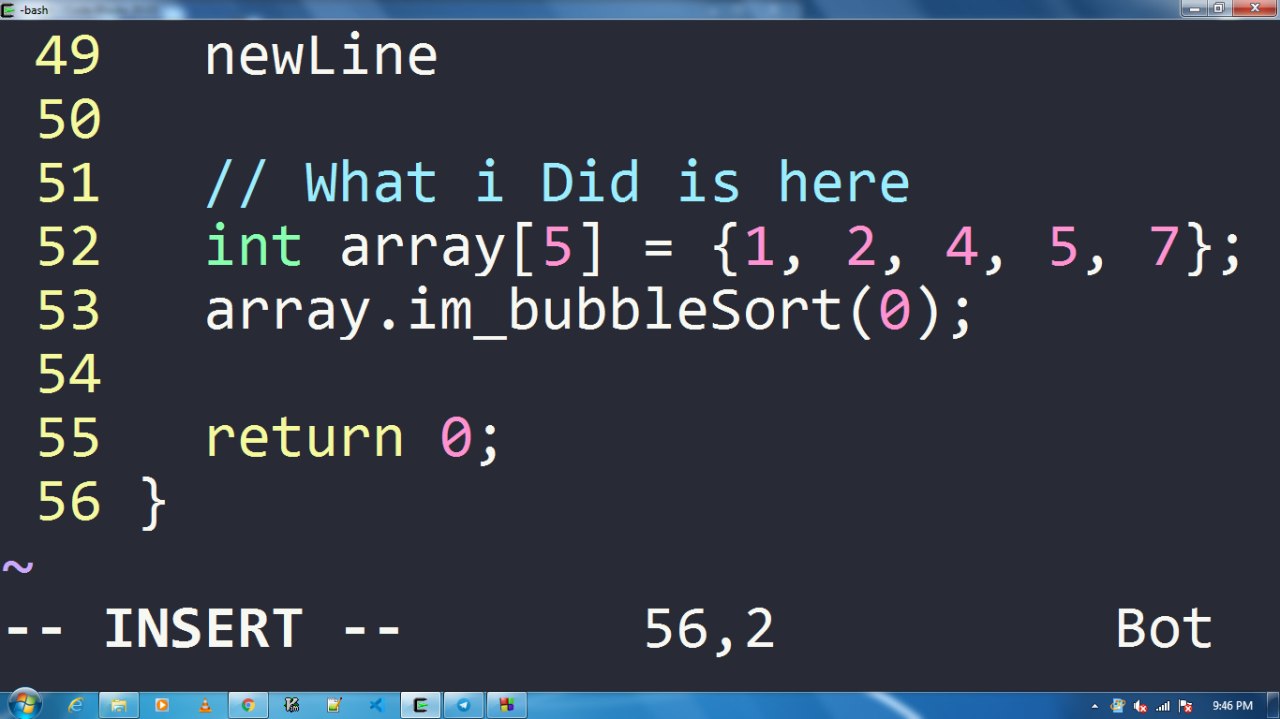
Can i put your bubble sort function in place of that std::sort line?
Anonymous
As we said here, doing python in C++
 Asdew
Asdew
Hahah, Rose reported you.
V01D
Hahah, Rose reported you.
The message was forwarded and rose reported that message so technicallllyyy...
Anonymous
sorry, I wrote the wrong code
Anonymous
yes using the value
V01D
Anonymous
template<T>f(...)
{
auto var = std::is_same<T, mytype>::value? f_that_return_mytype():f_that_return_another_mytype();
}
Anonymous
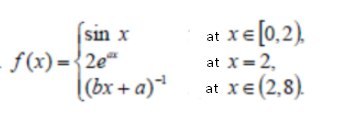
I have an error
 nemesic
help me
Anonymous
👍, yes true is this
nemesic
 nemesic
#include <iostream>
#include "windows.h"
using namespace std;
int main()
{
SetConsoleCP(1251);
SetConsoleOutputCP(1251);
int a, x, b, e;
cout << "Enter the number:" << endl;
cin >> x >> a >> b >> e;
if (x < 0)
cout << sin(x) << endl;
else
if (x = 0)
cout << (pow((2 * e), a * x)) << endl;
else
if (x = x > 0, x < 8)
cout << (pow((b * x + a), -1)) << endl;
system("pause");
return 0;
}
Rohan
Windows 7 is a liability.
It has reached EOL and you may be extremely vulnerable
what you mean by that???
nemesic
this true?
nemesic
I just almost do not understand, I am a beginner (
nemesic
i am 1 course first time c ++
Anonymous
Hahah, Rose reported you.
Yeye that guy couldn't join. So i forwarded the message and tagged admemes
Anonymous
how do i specify T to be both an std::output_iterator and an std::forward_iterator?
Rohan
May I DM you???
Rohan
Oh'k dhanyewaad
V01D
Uhh.
Google memory segment layout bootsector
V01D
I kinda wanna know too
V01D
I think an OS can choose what memory to segment.
Like with paging or something
Anonymous
no i want T to satisfy both output iterator and forward iterator requirements
Talula
Uhh.
Google memory segment layout bootsector
Depends on the processor type 16 bit had 65536... but now I think it's all direct access... there are no segments.
Segments were originally created for 8 bit addressing system.
Anonymous
no i want T to satisfy both output iterator and forward iterator requirements
The type std::iterator_traits<It>::reference must be exactly
T& if It satisfies OutputIterator (It is mutable)
const T& otherwise (It is constant),
there is this named requirements test. but i wanted to merge the two concepts directly
Anonymous
no. a forwarditerator can be dereferenced to an lvalue only if the iterator also satisfies outputiterator
Anonymous
oh sorry. i forgot that const T& is also an lvalue
Anonymous
i meant assignable
Anonymous
if x is a forward iterator, then *x is assignable to only if x also satisfies output iterator
Anonymous
no. that it shouldn't be read-only. i want to guarantee that i can write to the dereferenced object.
Anonymous
*x = value; should work for some forward iterator x
Anonymous
what else does being an output iterator guarantee
Anonymous
no ;_;
 olli
olli
what else does being an output iterator guarantee
by implementing these functions your iterator should satisfy it?
bool operator==(const Iterator& rhs) const;
bool operator!=(const Iterator& rhs) const;
// forward iterator
Iterator operator++(int);
Iterator& operator++();
const_reference operator* () const;
const_pointer operator->() const;
Iterator operator+ (difference_type v) const;
// output iterator
reference operator* ();
pointer operator->();
Anonymous
by implementing these functions your iterator should satisfy it?
bool operator==(const Iterator& rhs) const;
bool operator!=(const Iterator& rhs) const;
// forward iterator
Iterator operator++(int);
Iterator& operator++();
const_reference operator* () const;
const_pointer operator->() const;
Iterator operator+ (difference_type v) const;
// output iterator
reference operator* ();
pointer operator->();
i don't want to implement an output iterator. i want to write a function whose template argument T should satisfy both std::forward_iterator and std::output_iterator concepts
olli
i don't want to implement an output iterator. i want to write a function whose template argument T should satisfy both std::forward_iterator and std::output_iterator concepts
why not just use these functions then? If T does not satisfy the requirements the compilation will fail?
Anonymous
no they are not required to do so.
https://en.cppreference.com/w/cpp/named_req/OutputIterator
output iterators are about writing to the pointed to object
Anonymous
why not just use these functions then? If T does not satisfy the requirements the compilation will fail?
yeye but concepts are supposed to get rid of 20,000 page template errors, that's why i wanted to use them
Anonymous
just somehow merge the two concepts into one and use it
Anonymous
yes. if T is not an output iterator (for example cbegin(), cend() combo), throw a template error using concepts
Anonymous
oh i just googled "how to write concepts C++" and found the simplest answer -
template<typename T>
concept output_forward_iterator = std::output_iterator<T> && std::forward_iterator<T>;
Edit for future reference - this is wrong as std::output_iterator needs two arguments. It is trivial to change this. However, the standard already provides iterator concepts related to permutation and sortability
Anonymous
https://godbolt.org/z/938Me7
Anonymous
By object i assumed the dereferenced object
Anonymous
Why would i even talk about assigning to the iterator itself. It is trivial.
Anonymous
if x is a forward iterator, then *x is assignable to only if x also satisfies output iterator
Here i mentioned i wanted to assign to *x
Anonymous
no. that it shouldn't be read-only. i want to guarantee that i can write to the dereferenced object.
Write to the dereferenced object, not the iterator. Here again
Anonymous
Do we need delete after new now for regular user-defined data structures, e.g., TreeNode? If we just quit the program without delete, will there be memory leak?
Anonymous
Do we need delete after new now for regular user-defined data structures, e.g., TreeNode? If we just quit the program without delete, will there be memory leak?
Yes. That is the *definition of memory leak
*Almost
Anonymous
Thanks Sir. I saw the Cpp answers on leetcode have new but not delete. I thought now delete is optional now.
Anonymous
E can be written into ≈ the operator=() member function exists
You were talking about streams and operator<< and forward iterators guaranteeing output iterator requirements/forward iterators being stronger than output iterators