 A
A


I am not able to understand the problems
Is there Any resources that can helps to understand this better?
 olli
olli
Can anyone please suggests that how can I solve the problems of Hackerrank?
practice.. start with the easy ones
A
practice.. start with the easy ones
But the syntax is different
So thats why I am not able to solve..
Can you please suggest another resources to understand this? Or that can help me in this regard?
Jussi
It does not
Jussi
If it was a 32-bit uint or 16-bit, then it would
Jussi
Endianness is BYTE order, not BIT order
 Ludovic 'Archivist'
How does endianness play any role in a BYTE?
Excuse my tiredness, I haven't slept in quite a while
 Neutronix
Hello guys, I'm new in C++
Neutronix
I don't understand how to connect a library in the main file
Neutronix
Could someone help me?
 Mohammad
Anonymous
Mohammad
Anonymous
This was ignored. Someone kindly explain.
Anonymous

 Deep
Deep
Anyone have notes for c++??
Anonymous
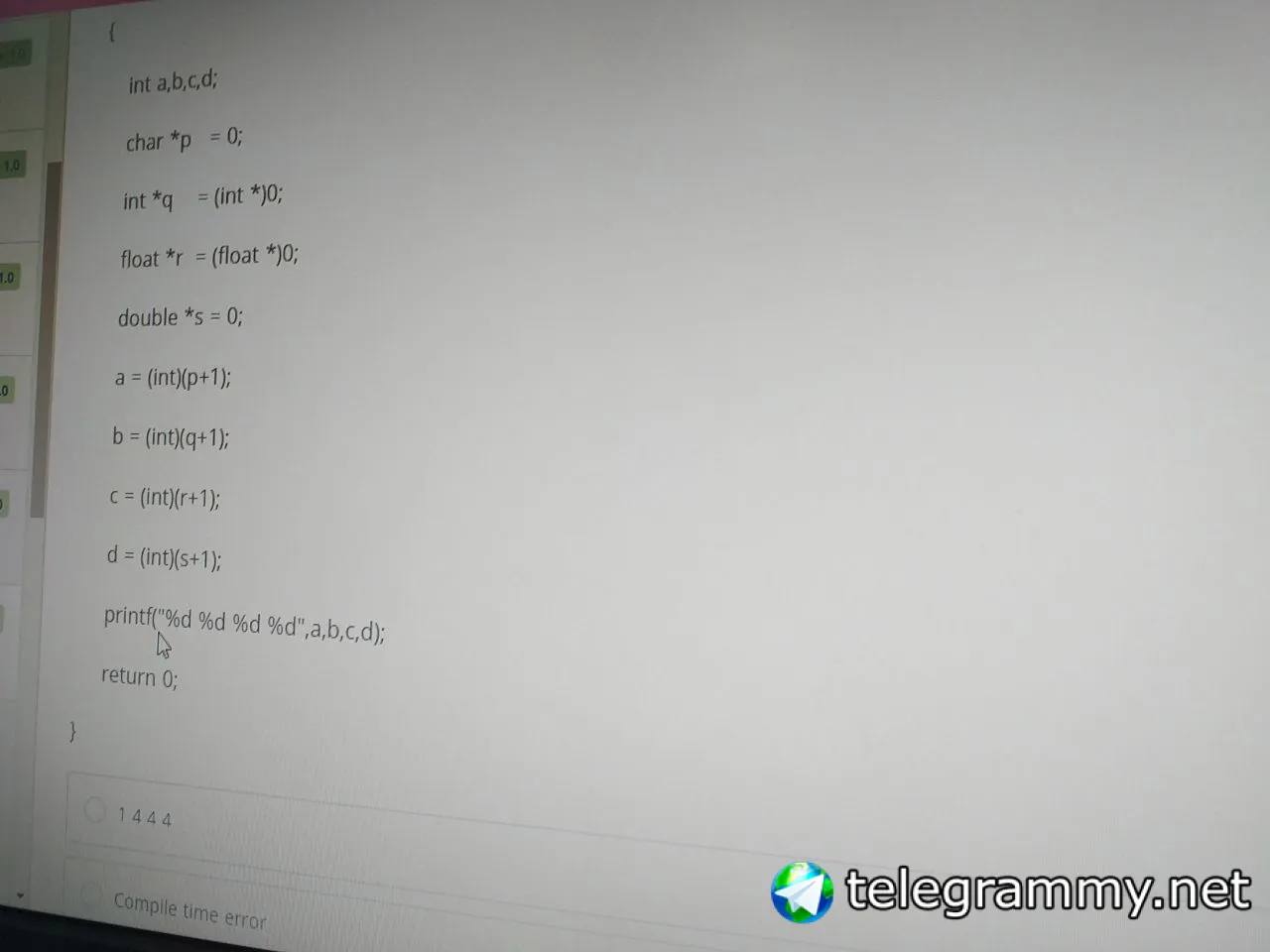 Anonymous
What is the output
Anonymous
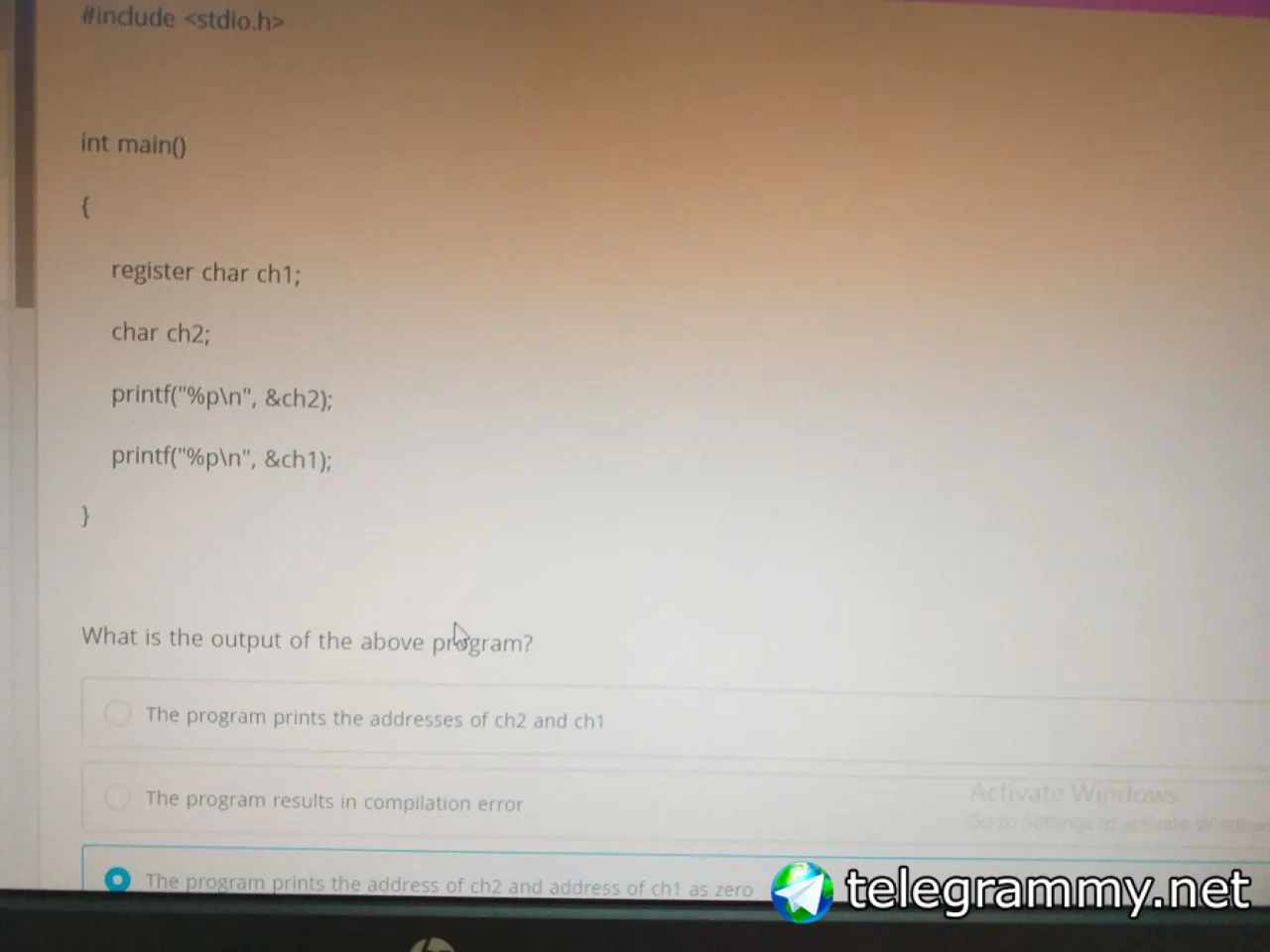 Anonymous
Will accessing the address of register variable give compile or run time error
Anonymous
?
Jussi
Read the #rules
Anonymous
Me ? Which does mine fall under ?
Jussi
"Requests such as 'do my homework'..."
Anonymous
no no it is not a homewok question
Jussi
Well why cant you just compile the program and see for yourself then?
Anonymous
it is just a mcq that came in my question paper
Jussi
mcq?
Anonymous
multiple choice question
Anonymous
I want the reason not the answer.
Anonymous
reason for the "char *p = 0;"
Mat
No pictures of screens. They're not easy to read
 Rumpelstiltskin
 Alexander
ide
Alexander
/get ide
 klimi
klimi
@Del4gen explain yourself or i am gonna ban you
Ludovic 'Archivist'
Anonymous
can someone dig deeper on this:
char *p = (char *)0;
Tim
how can i store the output from valgrind to a files
 YVEF
YVEF
Hi everyone. Anybody here use WinApi?)))
 Dima
YVEF
Dima
YVEF
Haha
Anonymous
It's just assignment of null pointer
Anonymous
And it's an old-style way
Dima
top 10 gross things:
0. winapi
Anonymous
T* ptr = nullptr
is a c++11 way
Dima
0 is nothing
Anonymous
0 is integer then what does (char*)0 mean inside the memory?
Dima
null - 0
Dima
whoever wrote (char*)0 must be retarded
Anonymous
I don't know who wrote that but this confuses the noobs
Anonymous
It's just casting to a char pointer
At machine level you don't have types at all
Types are a high-level abstraction
Anonymous
 Anonymous
Is this right ?
when we write char *p = (char*) 0; then 0 is being type casted to char*.
Anonymous
how does (char*)0 mean NULL?
Anonymous
Is this right ?
when we write char *p = (char*) 0; then 0 is being type casted to char*.
Yeeees, that's what I've told you like 5 mins ago
Anonymous
so what does "0 is being type casted to char*." mean?
Anonymous
I would have understood had it been some integer pointer in place of 0 but seeing 0 confuses me.
Anonymous
In c++ it's just
#define NULL 0
Anonymous
okk
Anonymous
0 and null mean the same?
Anonymous
Yes
Anonymous
int i = 9;
int *p = &i;
and then
char *c = (char*)p;
is understood
Anonymous
so what does "0 is being type casted to char*." mean?
"A value of a type T1 is being casted to a type T2" means you can use operations associated with the type T2 on the value
Anonymous
but (char*) 0 is not understood
Anonymous
int i = 9;
int *p = &i;
and then
char *c = (char*)p;
is understood
And how do you understand it?
Anonymous
it means that c will now point to the first byte of the 8 bytes to which p was pointing to.
means
that *(p+1) would give the value of location present at "(address of i) + 4 or 8(architecture dependent)"
and *(c+1) would mean the second byte of these 8 bytes which are occupied by the variable i.
Anonymous
so *(c+1) increments by 1 and prints the value
whereas in case of *(p+1) increments by 4 and prints the value which will be some garbage in this case.