 Anonymous


It can be solved just by using array indexing and deleting
Anonymous
I will post my code to this tomorrow in python 3
Anonymous
It can be solved just by using array indexing and deleting
The test codes have around 100000 integers as input
 Pavel
Pavel
I didn't got what you said😅.
I'm not sure I understand it either :)
I mean that complexity can be something like O(n), if I'm right
Anonymous
I'm not sure I understand it either :)
I mean that complexity can be something like O(n), if I'm right
Yeah if it works with one loop
Anonymous
Python can easily handle big data
Anonymous
Python can easily handle big data
👌 will wait for your code... Maybe I can convert it into c++ , i know a little python
Pavel
Yeah if it works with one loop
Exactly.
My idea is, you have one loop
Before it you remember the first value as previous and start the loop from the second item
Also have count and max_count values set to 0
In the loop
1) you check that the value is bigger than previous
1.1) if 1) is true, you increment count and remove the value
1.2) if not, you check that count bigger than max_count
1.2.1) if 1.2.1) true then max_count = count
1.2.2) set count to zero
1.2.3) set previous to current value
max_count (or -1) probably would be the answer
Pavel
Numbering is broken by the way :)
Pavel
Hope you get the idea, but not sure if it works :)
Anonymous
After removing the larger values , I will be left with another small array of levels of pesticides and this again needs to be sorted out by removing the rightside value if it's bigger
Anonymous
So doing it again will need an another loop
Pavel
After removing the larger values , I will be left with another small array of levels of pesticides and this again needs to be sorted out by removing the rightside value if it's bigger
My idea that in this loop you always keep the part on the left in the state when there are no ascending values. So after this loop you'll get the result as if you do all the loops.
The difference with the approach that is described in the task, that here you always look at the last valid value. Not on the value that was probably removed.
Anonymous
Ok wait, i got what you said
Anonymous
I will implement it tommorow morning.
Anonymous
Thanks btw, nice approach
Anonymous
I think it will work
 Gyanendra
Pavel
Gyanendra
Pavel
I think it will work
Oh, and also, I think the removement of elements can be eliminated here somehow. It can be faster without removement, also in real world situation you may want to keep the data immutable.
Anonymous
Also if I remove elements then step 1.2.3 messes up
Anonymous
Not waiting for tommorow morning. I'm doing it now
Pavel
Also if I remove elements then step 1.2.3 messes up
No, it shouldn't, because you don't need to save value of removed item (it doesn't matter what value the deleted item had)
Anonymous
Ok, I'm trying.
Anonymous
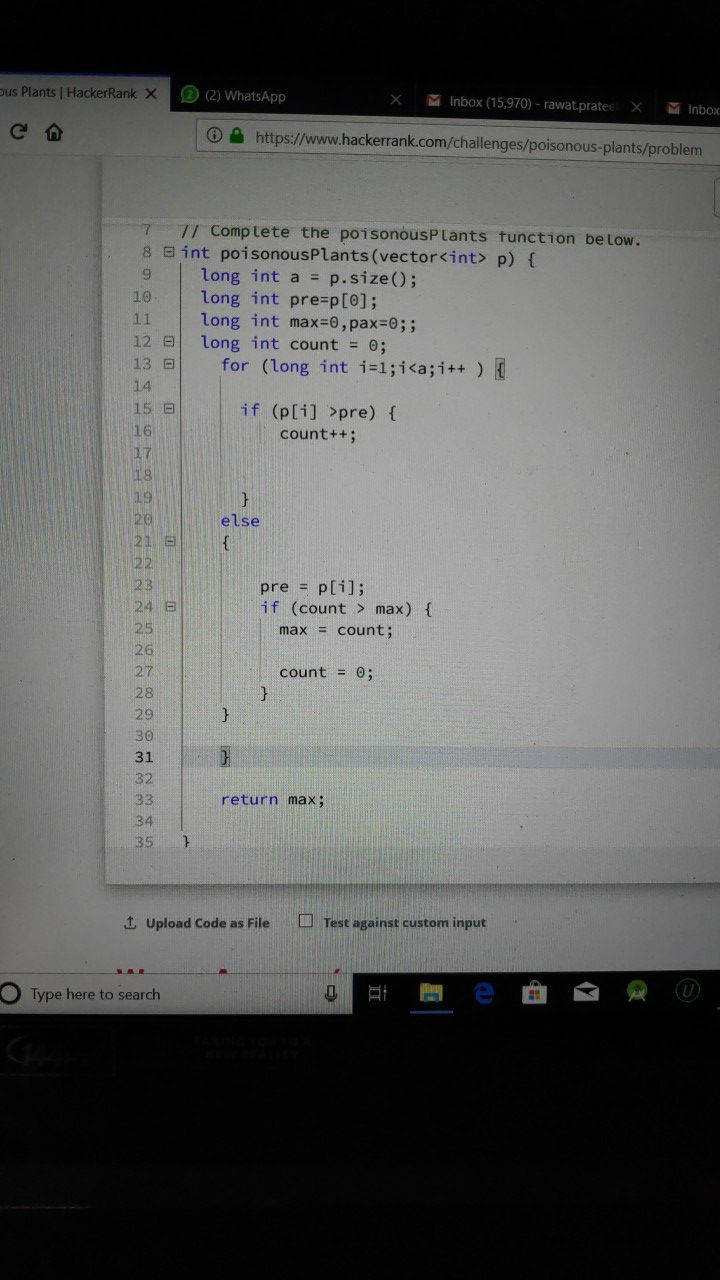
I tried and the code doesn't works😢.
Anonymous
 Anonymous
Ignore unnecessary declared variables.
IH
Thanks
 Dima
Dima
Welcome
 klimi
klimi
Welcome
Pavel
Oh, yeah, there's is a mistake in my previous algorithm.
The original algorithm can delete several consequent values in one iteration (I didn't consider this) but stops deleting values when it incounters one that was not bigger than previous one. Neighboring values change over iterations, but the good thing, that they change only from left to right.
So we need to find biggest count of small ranges of ascending values inside bigger ranges between the approved values (that will go to the final list).
Pavel
Basically in 2 3 4 3 1 in this case we know that
2 1 going to be left
But in two iterations
2 3 5 4 1 = 2
2 4 1 = 1
2 1 = 0
Where this going to be unchsnged
3 2 1 = 0
Pavel
Inside of if p[i] > pre we probably need to check that p[i] <= p[i-1] and only in this case increment count.
But then the result is going to be smaller by one if it's non-zero.
I think we can just do something like
if (count != 0) count++;
Before returning the value.
I think it can be made more elegantly than this, but I'm too lazy to think now.
Also, you need a check in case the vector is empty, not to crash.
Pavel
I tried and the code doesn't works😢.
Yes, my explanation is above this message, I still have no idea whether the new solution is working or not :D
Anonymous
Why we get floating point error in c?
Searched google but didn't understand
Anonymous
I read that
Anonymous
صباح
 Pavel
Pavel
This doesn't works for 4 5 3 2 1 6
Ah, shi.. yes, incrementing one with that condition was a stupid inea.
Then.. we can create a new bool flag, representing whether the last processed item was good or going to be deleted. Set it to true, when we in p[i] > pre block and set it to false in the else block of this if.
And in the beginning of the block where we setting it to false do
if (isValueWasBad) count++;
So we will still increment the value in case we shold have one as the answer.
5a5d9e25c9b34aa698be758bac34bda6
remove value from vector is too inefficient. try to build a new vector only from required values. without removing elements by one
Dima
Anonymous
Suggest best IDE for C++
Pavel
remove value from vector is too inefficient. try to build a new vector only from required values. without removing elements by one
If you about what I wrote, I used "removing" to refer to part of the original alghoritm, that is being analyzed. So no removement is needed now. You can find the task and some code examples above, if you're interested.
5a5d9e25c9b34aa698be758bac34bda6
 Anonymous
I use ubuntu 18.04
 桃桃乌龙
桃桃乌龙
No vim is not an IDE but an editor
桃桃乌龙
You can install plugins to make it more like an IDE
Anonymous
Why do you say its best?
5a5d9e25c9b34aa698be758bac34bda6
visual studio code or qt creator or clion. if you want gui
Pavel
I use ubuntu 18.04
Well, there are lot of choices. I would suggest to try QtCreator, especially if you have not very powerful PC. But actually if I were you, I would open some list of "best c++ IDE" from the internet and try them all, to see which you like the most.
Anonymous
Dima
Lol I think we should make a rule, if someone offers vim as an ide to use you’ll get instant ban.
Dima
nano ( ͡° ͜ʖ ͡°)
5a5d9e25c9b34aa698be758bac34bda6
holy war
桃桃乌龙
Each one have it’s pros and cons
桃桃乌龙
AFAIK Clion is power consuming
Dima
yeah
ῳɧıɬɛཞơʂɛ
+1
桃桃乌龙
It’s powerful though, but maybe it’s not a good idea to use it on a lowend machine
桃桃乌龙
It just eats all your CPU and RAM
Dima
At what level of being with a lowend machine you must be to use vim? lol.
Dima
80s?
桃桃乌龙
Like, new MacBook
Dima
Nah, I am using base pro model and it’s good ( ͡° ͜ʖ ͡°)
 Defragmented
At what level of being with a lowend machine you must be to use vim? lol.
i use vim as ide on mobile phone
Dima
Nevermind, gone ot a bit
Defragmented
history consist of loops
Defragmented
each time new type of device is made (smaller and more convinient), vim again becomes more suitable because its lightweight
phones today, smart glasses tomorrow
ῳɧıɬɛཞơʂɛ
🤔
many
Are there built-in map, reduce and filter lambda functions in modern C++?
many
I've been using old style and not familiar with the modern C++
 Francisco
Are there built-in map, reduce and filter lambda functions in modern C++?
What you mean? There's lambdas, there's a std::map container and there's a std::reduce algorithm
many
What you mean? There's lambdas, there's a std::map container and there's a std::reduce algorithm
Like array.map(function(i)...)
Pavel
Like array.map(function(i)...)
There are generate, accumulate and other alghorithms in STL, but they're not lazy as I know, so they'll calculate all the values even if you'll discard some of them later.