sad
Necrobumper
 Elnee
Elnee


 klimi
klimi
 Ибраги́м
Lol
I just measure how many lines there and make shallow judgments xD
Don't worry dear, u've made worse life decisions.
 MᏫᎻᎯᎷᎷᎬᎠ
And type? Possibly... Not sure
yeah
it has the type information such as size to calculate the access
so if your type size is 4 and you want to access the 3rd element
the calc is just 3 * 4 = the index of the array
MᏫᎻᎯᎷᎷᎬᎠ
Don't worry dear, u've made worse life decisions.
Really?
My life was going very well this far
Anonymous
template <typename _Up, typename _Ep, typename = void>
struct _Ptr {
using type = _Up*;
};
template <typename _Up, typename _Ep>
struct _Ptr<_Up, _Ep, __void_t<typename remove_reference<_Ep>::type::pointer>> {
using type = typename remove_reference<_Ep>::type::pointer;
};
this is in __unique_ptr_impl of libstdc++. i don't understand line 6
Edit: nvm i got it
 Nils
Nils
How do I execvp() without replacing the current process?
Nils
Can I pass the some pointer to fork()?
 Alex
Alex
or try system
Nils
inside child process call execvp
but how does the child know that it's a child and which arguments to pass to execvp?
 vinícius*
you can tell childs by the PID value
vinícius*
the child will have PID == 0
Alex
but how does the child know that it's a child and which arguments to pass to execvp?
fork returns zero for child, and pid of child for parent
Nils
fork returns zero for child, and pid of child for parent
but how do I pass the arguments for execvp() to the child?
Nils
Do I need a fd or something like that?
vinícius*
the child will have access to all the variables the parent process had at the moment of forking
Nils
the child will have access to all the variables the parent process had at the moment of forking
so they won't be reinitialised?
vinícius*
nah
Alex
but how do I pass the arguments for execvp() to the child?
you can read from stdin in child or use IPC to pass data from parent
vinícius*
you're trying to make a shell ?
vinícius*
well, you can do something like this: char ** aux = malloc(read_from_pos * sizeof(char *));
for(i=0; i<read_from_pos; i++)
aux[i] = parsed[i];
if (fork() == 0)
{
execvp(aux[0], aux);
fprintf(stderr, "%s: command not found.\n", aux[0]);
}
Nils
vinícius*
nope, anywhere
vinícius*
fork will always run from where it's called
vinícius*
yeah
vinícius*
it'll inherit the file descriptors of the parent process, afaik
vinícius*
you wanna use dup2?
Nils
But I am too much of a beginner in file descriptors, tbh
vinícius*
I want to somehow read the process output
as in saving it to a file or printing it to stdout?
vinícius*
I imagine you can do something like this:
vinícius*
int fds[2];
const char *argv[3] = {"/bin/ls", "-li"};
pipe(fds);
if (fork() == 0) {
close(fds[0]);
dup2(type[0] == 'r' ? 0 : 1, fds[1]);
close(fds[1]);
execvp(argv[0], argv);
exit(-1);
}
close(fds[1]);
FILE * proc_output = fdopen(fds[0], type);
vinícius*
the child's output should be contained within that file, so you can read it with fscanf, fread, whatever
Nils
Can I wait for the fork()ed process to having exited?
vinícius*
yeah
vinícius*
wait(0), yup
Nils
thx
Nils
int fds[2];
const char *argv[3] = {"/bin/ls", "-li"};
pipe(fds);
if (fork() == 0) {
close(fds[0]);
dup2(type[0] == 'r' ? 0 : 1, fds[1]);
close(fds[1]);
execvp(argv[0], argv);
exit(-1);
}
close(fds[1]);
FILE * proc_output = fdopen(fds[0], type);
struct databuffer db_fromcmd(const char **command) {
struct databuffer outdb;
struct databuffer readdb;
db_init(&outdb);
int stdout_backup = dup(1);
dup2(memfd_create("pipe", 0), 1);
if (fork() == 0) {
execvp(command[0], command);
}
FILE *proc_out = fdopen(1, "r");
while (!feof(proc_out) == 0) {
char outb[16];
fread(outb, sizeof(outb), 1, proc_out);
readdb = sized_db(outb, sizeof(outb));
db_append(&outdb, &readdb);
}
wait(0);
close(1);
dup2(stdout_backup, 1);
return outdb;
}
Nils
Right?
Nils
Oh wait I should not forget to dup back the original stdout
Nils
Done
piggyho
 Anik
Anik
can u explain me how can i imorove C+
Anonymous
Coding
 q1248 •卜
great
/home/aleksandr/
Nils
Nils
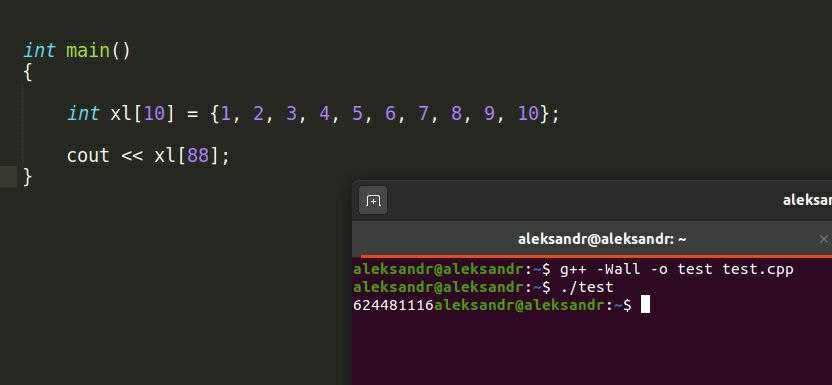
If you want truly efficient bound checking use c++ std::vector
/home/aleksandr/
Okey, thanks :)
Nils
Okey, thanks :)
Or, if you need the bound check while iterating only, use a so-called "null-terminator"
Nils
It is a special byte that marks the end of the array
/home/aleksandr/
I will consider, thank
 Liam
Anonymous
Liam
Anonymous
Hello, how can we use c++ for hacking? Is there any good website or something. I know c++ already
...
What
 Mr.James
Hello, how can we use c++ for hacking? Is there any good website or something. I know c++ already
No uh can't hack by using c++ still uh can create viruse by c++
Anonymous
/get cppbookguide
వ్లాదమిర్ పుతిన్
https://dpaste.org/z2eC#L49
వ్లాదమిర్ పుతిన్
am only getting IP from the last line. any fix?
Alex
what do you want to get?
Anonymous
Anonymous
A person, who thinks that (s)he knows C++, knows almost nothing about C++
Anonymous
A person, who thinks that (s)he knows C++, knows almost nothing about C++
No I mean the basics, I have been learning it for a couple of months now (and still learning)