 Artöm
Artöm


Write it yourself
 rex
rex
i cant use strrev function because it is not defined in gcc compiler
rex
and again if i reversing the string character wise just tell me logic
Artöm
Use for, swap i and (last-i) chars, i from 0 to (length/2)
Artöm
C or C++?
Artöm
i cant use strrev function because it is not defined in gcc compiler
You may try adding -D_GNU_SOURCE to compiler invocation
 Pavel
Pavel
I want to implement a simple float comparison with epsilon in my project. But I also want to check with assertions that the values have comparable magnitudes with the given epsilon (so no one tries to compare one billion with something else using epsilon of 0.0001f). Is there a way to achieve that?
bool AreFloatsComparable(float a, float b, float epsilon)
{
return ???
}
bool AreEqualWithEpsilon(float a, float b, float epsilon)
{
Assert(AreFloatsComparable(a, b, epsilon), "error: ...");
return fabs(a - b) < epsilon;
}
 Mar!o
Mar!o
[[nodiscard]] inline NO_ALIAS auto is_zero(const f32 v) noexcept->bool { return abs(v) < 1e-6f; }
[[nodiscard]] inline NO_ALIAS auto is_one(const f32 v) noexcept->bool { return is_zero(v - 1.f); }
[[nodiscard]] inline NO_ALIAS auto near_equal(const f32 a, const f32 b) noexcept->bool {
if (is_zero(a - b)) return true;
const s32 a2 = *reinterpret_cast<const s32*>(&a);
const s32 b2 = *reinterpret_cast<const s32*>(&a);
if (a2 < 0 != b2 < 0) return false;
return abs(a2 - b2) <= 0b0100;
}
[[nodiscard]] constexpr NO_ALIAS auto within_epsilon(const f32 a, const f32 b, const f32 epsilon) noexcept->bool {
const f32 num = a - b;
return -epsilon <= num && num <= epsilon;
}
Mar!o
Here just replace f32 with float and s32 with int, NO_ALIAS with __declspec(noalias) (only if you are on windows, otherwise remove it).
Mar!o
This is code for correctly comparing floating point numbers using epsilons :)
Mar!o
Your welcome, just write if you need more help :)
Mar!o
Remember it is C++17 if you need it for C or an older std just write too
Pavel
Remember it is C++17 if you need it for C or an older std just write too
I need it exactly for C++17 :)
Mar!o
Alright :)
 Álvaro
Hi everybody
Álvaro
Just entering this awesome world of C in 42Madrid
Álvaro
Hope learn a lot from you
 klimi
klimi
Hope learn a lot from you
most things are up to you tho. You are the person who is so awesome to learn all the things
Álvaro
😊👍
 Lauri
Lauri
dayan:
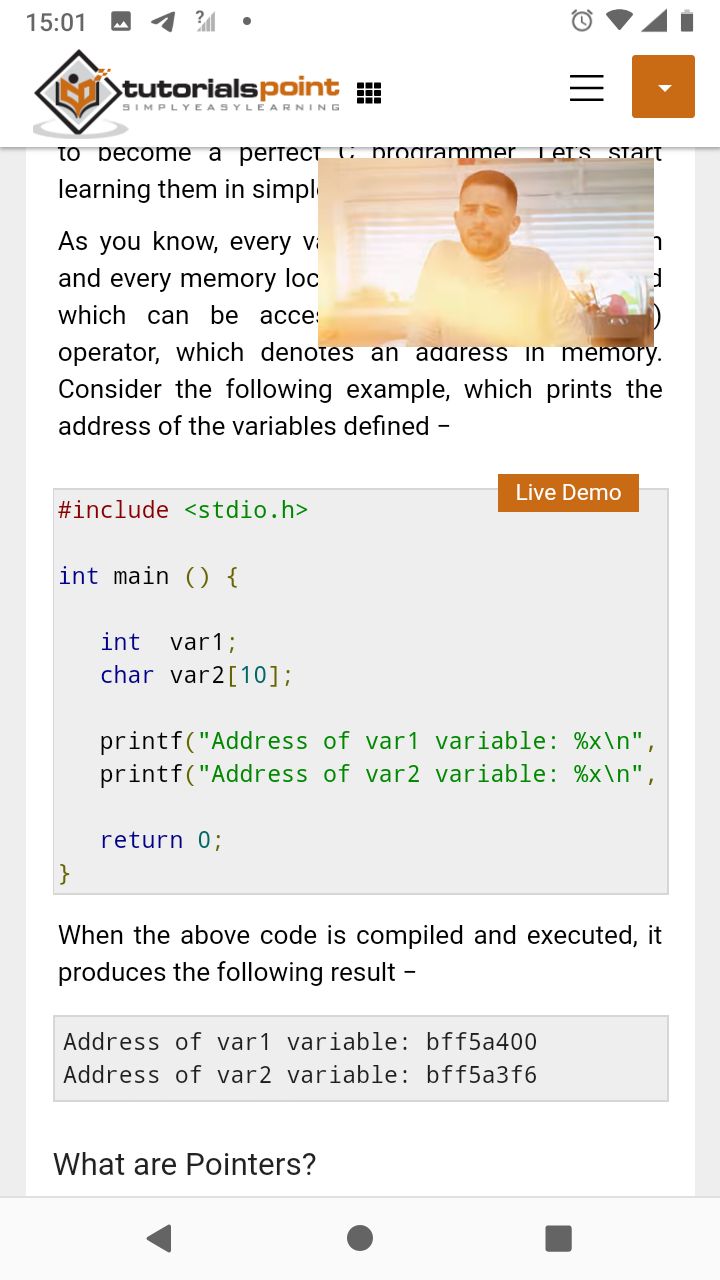
What getting memory location of variable can be used for
Useful for
klimi
um changing the variable or reading it? (im no pro)
Lauri
No
klimi
okay.
Lauri
 klimi
Lauri
klimi
Lauri
What can I do with that memory adress
Mar!o
It is useful in many cases for example function parameters: A pointer is like an int, but it contains a memory adress. If you want to pass a big object to a function, it would copy the object from the callsite. If you pass a pointer it only copies the pointer and you can access the big data using the pointer
Mar!o
Which is of course much faster
 桃桃乌龙
桃桃乌龙
Learn yourself some assembly language and you’ll find out that pointers is pretty much everywhere.
Pavel
[[nodiscard]] inline NO_ALIAS auto is_zero(const f32 v) noexcept->bool { return abs(v) < 1e-6f; }
[[nodiscard]] inline NO_ALIAS auto is_one(const f32 v) noexcept->bool { return is_zero(v - 1.f); }
[[nodiscard]] inline NO_ALIAS auto near_equal(const f32 a, const f32 b) noexcept->bool {
if (is_zero(a - b)) return true;
const s32 a2 = *reinterpret_cast<const s32*>(&a);
const s32 b2 = *reinterpret_cast<const s32*>(&a);
if (a2 < 0 != b2 < 0) return false;
return abs(a2 - b2) <= 0b0100;
}
[[nodiscard]] constexpr NO_ALIAS auto within_epsilon(const f32 a, const f32 b, const f32 epsilon) noexcept->bool {
const f32 num = a - b;
return -epsilon <= num && num <= epsilon;
}
By the way, there seems to be a UB (at least in general case, where strict aliasing is enabled).
Type punning between these values is violating the rules of strict aliasing.
See the last code example in the Notes section
https://en.cppreference.com/w/cpp/language/reinterpret_cast
These lines
const s32 a2 = *reinterpret_cast<const s32*>(&a);
const s32 b2 = *reinterpret_cast<const s32*>(&a);
can be replaced with these for example
s32 a2, b2;
memcpy(&a2, &a, sizeof(f32));
memcpy(&b2, &b, sizeof(f32));
More detailed explanation
https://gist.github.com/shafik/848ae25ee209f698763cffee272a58f8
klimi
@bastyav you alright dude?
Mar!o
By the way, there seems to be a UB (at least in general case, where strict aliasing is enabled).
Type punning between these values is violating the rules of strict aliasing.
See the last code example in the Notes section
https://en.cppreference.com/w/cpp/language/reinterpret_cast
These lines
const s32 a2 = *reinterpret_cast<const s32*>(&a);
const s32 b2 = *reinterpret_cast<const s32*>(&a);
can be replaced with these for example
s32 a2, b2;
memcpy(&a2, &a, sizeof(f32));
memcpy(&b2, &b, sizeof(f32));
More detailed explanation
https://gist.github.com/shafik/848ae25ee209f698763cffee272a58f8
You are right the memcpy solution is better but the old one shouldn't be a ub because a2 and b2 are copies of the dereferenced punned pointer which are not affected by the address meaning that there is no aliasing second pointer to them. Gonna read the post tough :)
Pavel
You are right the memcpy solution is better but the old one shouldn't be a ub because a2 and b2 are copies of the dereferenced punned pointer which are not affected by the address meaning that there is no aliasing second pointer to them. Gonna read the post tough :)
Probably, but the compiler is free to do any wierd stuff in this case, so I would be at least aware of this
BTW, I forgot to include one of the links (updated my message now)
https://en.cppreference.com/w/cpp/language/reinterpret_cast
Mar!o
Idiriz906
I am human
Idiriz906
😭😭😭why the admins restricted me to write here-!!!!
Idiriz906
Would not i get here benifits from the experiers 😭😭
Artöm
Remember it is C++17 if you need it for C or an older std just write too
14 if remove nodiscard
Naveen
Hi
 MilkBeforeCereal
lul
klimi
How are u and may i know from where are talking
i am talking from my chair and i am well thanks for asking
kenny3fcb
lol
 Dima
Dima
lol
MilkBeforeCereal
lulmao
klimi
in what language
MilkBeforeCereal
Hindi
klimi
where i live
 I_Interface
#ot
 Zel
Zel
Hindi? South Asia probably India.
MilkBeforeCereal
What u think
what's the point in asking where someone lives on the internet? They could say literally anything
Dima
MilkBeforeCereal
wait no
Zel
lewd
rex
i want to copy the lines whose size is >20