 Anonymous


hmm
Anonymous
it means it gives its base address in return
 Pavel
Pavel
Hey ! Danya
Why is "abc" considered const char * and not const char[n+1] ?
well, it can be used like that, but then you bound with the size of the array and can't use it in the more generic algorithms
https://ideone.com/y5rrCg
Pavel
That was C++
here goes C (have no idea how to print strings in C)
https://ideone.com/j0KJEO
Anonymous
printf("%s",array_name);
Anonymous
what are the additional functionalities that you are talking about? Can you elaborate on those algorithms?
Pavel
what are the additional functionalities that you are talking about? Can you elaborate on those algorithms?
I mean if you want to make a function that does something with a string (regardless its size) you need to pass a pointer to const char anyway.
Pavel
Or you can only make a function for a string of a specific size that accepts arrays.
Anonymous
I mean if you want to make a function that does something with a string (regardless its size) you need to pass a pointer to const char anyway.
OK, that is convincing to understand.
But, I am not able to make choice over what are string literals?
Are they const char* or const char[]?
Pavel
OK, that is convincing to understand.
But, I am not able to make choice over what are string literals?
Are they const char* or const char[]?
Regarding the documentation I've sent, it's const char[N] where N is size of the string + 1.
https://en.cppreference.com/w/cpp/language/string_literal
But it's C++, I don't have info about C, but guess that you can Google the specification for C.
Anonymous
In the reference you provided right under the "const_cast" example, it is written that :
In C, string literals are of type char[], and can be assigned directly to a (non-const) char*
 olli
olli
OK, that is convincing to understand.
But, I am not able to make choice over what are string literals?
Are they const char* or const char[]?
a string literal is of type const char[N]
Anonymous
Regarding the documentation I've sent, it's const char[N] where N is size of the string + 1.
https://en.cppreference.com/w/cpp/language/string_literal
But it's C++, I don't have info about C, but guess that you can Google the specification for C.
In the same para, It is also written that :
but deprecated it, as literals are const in C++
Anonymous
 Pavel
Pavel
In the reference you provided right under the "const_cast" example, it is written that :
In C, string literals are of type char[], and can be assigned directly to a (non-const) char*
Yes, but that's the general case of arrays. Two specific things here: first that the array is static so you don't need to care about its life time, the second is that you have a terminating character, so you don't care about storing the size.
If you have (or allocate) an usual array and get a pointer to it, you need to store the size somewhere in order to work with the array through the pointer.
Anonymous
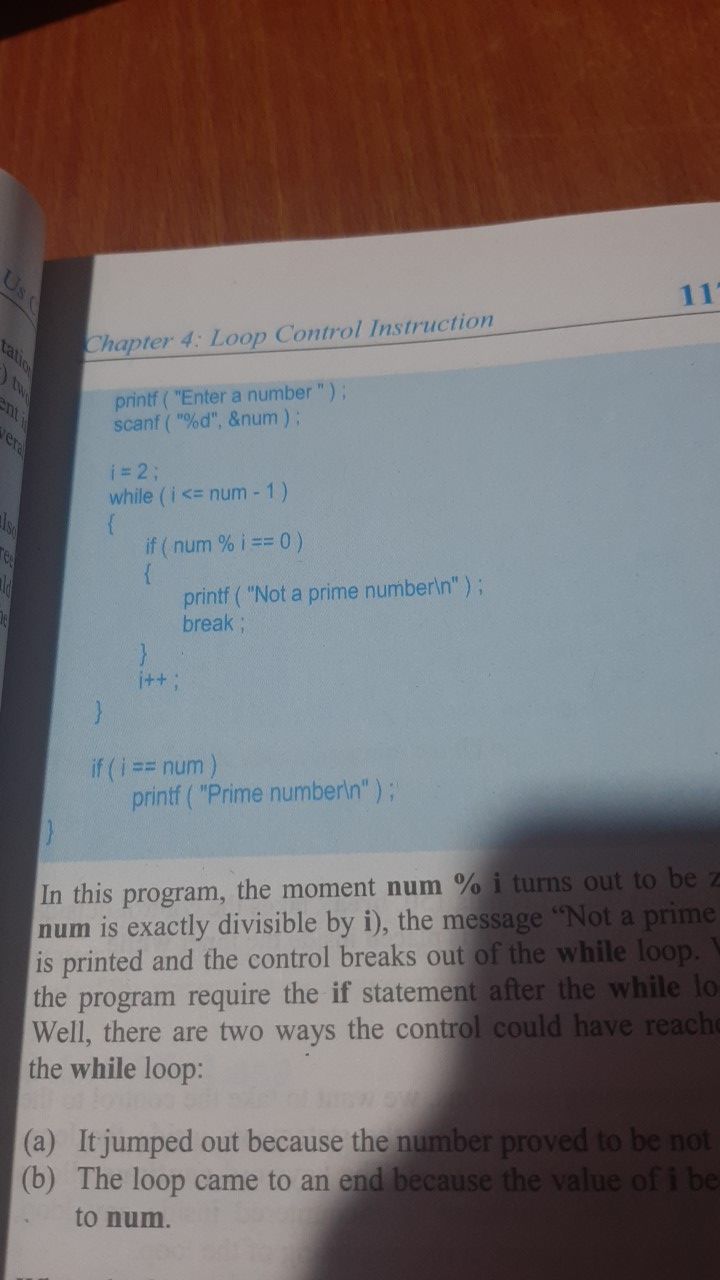
Any one pls explain this program
Anonymous
 Anonymous
Pietrø
Pavel
Anonymous
Pietrø
Pavel
In the same para, It is also written that :
but deprecated it, as literals are const in C++
Yes, but that's another thing, it's about non-const char pointer. It's useless to have a non-const pointer to a string literal, as you should never modify the string (so const disallow the incorrect behavior)
Pietrø
With the cicle
Pietrø
Num % i means num/i rest
Pietrø
And then it controls the rest
Anonymous
So what you are saying is that string literals are immutable and storing them is illegal in char[] or pointing them by char* is also illegal.
Anonymous
and so const before char[] or char * should be used to prevent un-defined behaviour.
Anonymous
So, finally the conclusion is that :
Originally, string literals are const char arrays.
Right?
Pavel
Anonymous
 Anonymous
3rd point in the photo.
Pavel
3rd point in the photo.
Interesting, I didn't know that
I'm actually not sure how char[] (without the size) is used.
olli
So, finally the conclusion is that :
Originally, string literals are const char arrays.
Right?
String literals are and have always been of type const char[N]
olli
By the rules of conv.array converting the type from const char[] to const char* is legal.
Anonymous
String literals are and have always been of type const char[N]
Yeah. It was just a doubt over const char[N] and const char *.
It has now been cleared.
olli
In C and old C++ version "converting" from string literals to char* was allowed, although modifying results in UB. Hence C++ decided to only allow const char* which increases consistency and decreases the chance of running into UB
Anonymous
What do you say of this?
Anonymous
Anonymous
Anonymous
Pavel
I didn't get why the contents of s7 should not be changed, why not?
Because it's UB
https://wiki.sei.cmu.edu/confluence/plugins/servlet/mobile?contentId=87152214#content/view/87152214
Not sure how it works with char[]
Pavel
Ok, seems like assigning to char[] creates a stack allocated array, that explains everything.
https://www.geeksforgeeks.org/whats-difference-between-char-s-and-char-s-in-c/
Anonymous
Ok, seems like assigning to char[] creates a stack allocated array, that explains everything.
https://www.geeksforgeeks.org/whats-difference-between-char-s-and-char-s-in-c/
Yes, it creates so you can modify the array
And it's called not assining, but copy-initilization
Anonymous
Because it's UB
https://wiki.sei.cmu.edu/confluence/plugins/servlet/mobile?contentId=87152214#content/view/87152214
Not sure how it works with char[]
Thanks.
It works fine with char []
char str[] = "string literal";
str[0] = 'S';
Anonymous
Thanks.
It works fine with char []
char str[] = "string literal";
str[0] = 'S';
It is an UB because it stores wtih an executable and has static storage duration. It is an UB when you are trying to change memory where the code is written
Anonymous
It is an UB because it stores wtih an executable and has static storage duration. It is an UB when you are trying to change memory where the code is written
That goes the same with a normal array containing a string literal. We are modifying the content of memory in run-time.
I didn't understand what do you mean by "where the code is written?" Not trying to change memory but contents of it.
Anonymous
No, when we have an array, it copies string literal to stack and that's why you have full access
Anonymous
You should understand that when you start running your executable, all the machine code it contains goes to the RAM. And string literals are stored aside with machine code in some protected memory segment, I guess. So, changing a content of that protected memory is UB
Anonymous
You should understand that when you start running your executable, all the machine code it contains goes to the RAM. And string literals are stored aside with machine code in some protected memory segment, I guess. So, changing a content of that protected memory is UB
Great, now string literals are stored in ROM, makes sense for causing UB.
Does it only happens when use of pointer to string literal?
Anonymous
Great, now string literals are stored in ROM, makes sense for causing UB.
Does it only happens when use of pointer to string literal?
Yes, because it points to an actual string literal
When you initilize an array with string literal, it coipies the literal to stack memory
Anonymous
 Sudip
Sudip
Any best compiler for c programme
Sudip
I am using dev c++
 ॐकार
Anonymous
ॐकार
Anonymous
What is object oriented ??
Real life object ?
Anonymous
#include <stdio.h>
void add(int a[10][10], int b[10][10], int m, int n)
{
int sum[m][n];
for (int i = 0; i < m; i++)
{
for (int j = 0; j < n; j++)
{
sum[i][j] = a[i][j] + b[i][j];
printf("%d\t", sum[i][j]);
}
printf("\n");
}
}
void main()
{
int i,j,m,n,o,p;
printf("Enter the no. of row and column of 1st matrix");
scanf("%d%d",&m,&n);
printf("Enter the no. of row and column of 2nd matrix");
scanf("%d%d'",&o,&p);
if(m==o && n==p)
{
int a[m][n];
printf("Enter the first matrix");
for(i=0;i<m;i++)
{
for(j=0;j<n;j++)
{
scanf("%d",&a[i][j]);
}
}
int b[m][n];
printf("Enter the second matrix");
for(i=0;i<m;i++)
{
for(j=0;j<n;j++)
{
scanf("%d",&b[i][j]);
}
}
add(a, b, m, n);
}
}
Anonymous
Someone help to remove error
 klimi
Anonymous
klimi
Anonymous
Guys does anyone have a starter book
 Anonymous
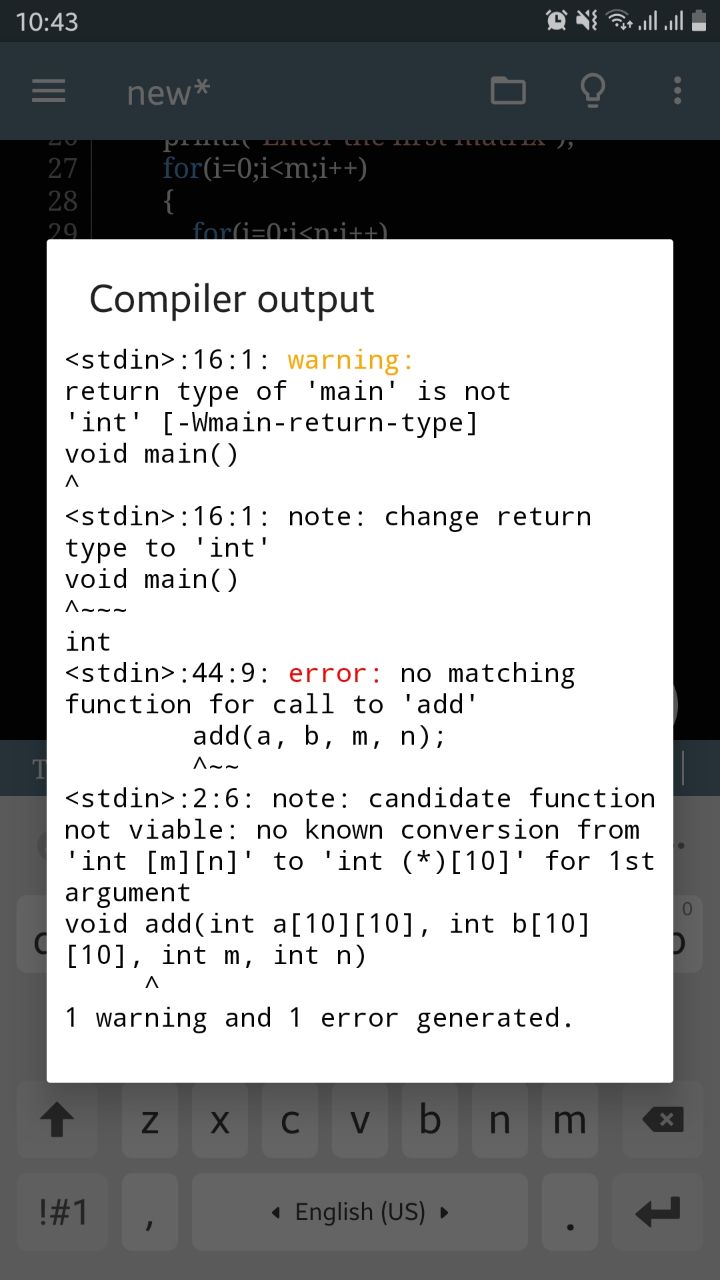
Getting this error
Ash
#include <stdio.h>
void add(int a[10][10], int b[10][10], int m, int n)
{
int sum[m][n];
for (int i = 0; i < m; i++)
{
for (int j = 0; j < n; j++)
{
sum[i][j] = a[i][j] + b[i][j];
printf("%d\t", sum[i][j]);
}
printf("\n");
}
}
void main()
{
int i,j,m,n,o,p;
printf("Enter the no. of row and column of 1st matrix");
scanf("%d%d",&m,&n);
printf("Enter the no. of row and column of 2nd matrix");
scanf("%d%d'",&o,&p);
if(m==o && n==p)
{
int a[m][n];
printf("Enter the first matrix");
for(i=0;i<m;i++)
{
for(j=0;j<n;j++)
{
scanf("%d",&a[i][j]);
}
}
int b[m][n];
printf("Enter the second matrix");
for(i=0;i<m;i++)
{
for(j=0;j<n;j++)
{
scanf("%d",&b[i][j]);
}
}
add(a, b, m, n);
}
}
First of all change return type to int.
And just use the pointer to get the base address of the matrix.
Ash
First of all change return type to int.
And just use the pointer to get the base address of the matrix.
Return type of main to int
Ash
So you can get the base address of the arrays
Ash
Guys anyone appearing for Kick Start 2019 - google hackathon!
Ash
?
 Daniele°
So, finally the conclusion is that :
Originally, string literals are const char arrays.
Right?
string literals is not const, is char[] but Is ub modify Memory.
On Digital Mars compiler you can write in string literals.
In some mcu you can write in string literals
Daniele°
In C
Daniele°
C++ have differnt rule
Anonymous
Does it comprise from beginner to advanced
 World Mobile Token Community
Hi buddies,
So I'm an newbie to programming and I have encountered a
case for which I suppose qualifies as an authentic question
in this awesome group. I am practising building programs which
are easy to maintain br localizing the effects to a class's data members
by accessing and manipulating the data members through their get
and set functions. In this regard I have two data members for which I
wish to change. After compiling, the set functions works well by changing the
values but the get functions can only return one of the data member values ata time
Now is there a way to write statements inside my get functions so that I can
obtain all the changed data member values without having to create multiple get functions
for each data member?
Regards
World Mobile Token Community
Kindly note I'm using C++
Anonymous
Hi buddies,
So I'm an newbie to programming and I have encountered a
case for which I suppose qualifies as an authentic question
in this awesome group. I am practising building programs which
are easy to maintain br localizing the effects to a class's data members
by accessing and manipulating the data members through their get
and set functions. In this regard I have two data members for which I
wish to change. After compiling, the set functions works well by changing the
values but the get functions can only return one of the data member values ata time
Now is there a way to write statements inside my get functions so that I can
obtain all the changed data member values without having to create multiple get functions
for each data member?
Regards
Having individual get and set functions for a data member is a good practice.
But creating getters and setters for each data member can ruin encapsulation though. Sometimes users of a class don't have to set a data member, sometimes they don't have to have a getter for it