 detergentTikiya


 Anonymous
Hello
Anonymous
Hello
detergentTikiya
 Artöm
detergentTikiya
Artöm
detergentTikiya
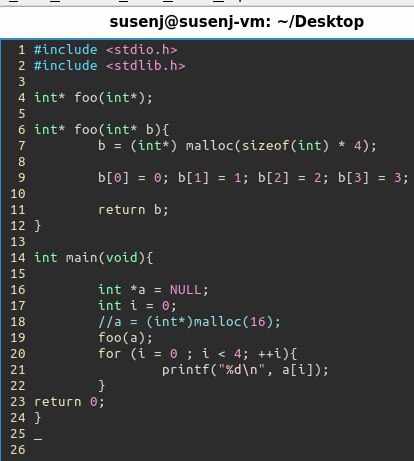
You change b and return it, but dont save return in main
I didn't get save return in main part
Artöm
a = foo(a)
detergentTikiya
Yes, I do change b, but the address which b is pointing to is what a is also pointing to.
Artöm
When you change b, a remains unchanged
detergentTikiya
a = foo(a)
I deliberately didn't do that.
Reason: malloc does allocation in a heap segment. That segment is available until we free or terminate the program.
Now b is pointing to contiguous blocks of 4 ints. So, if I know address contained in b, I should be able to know about values also that are contained in those 4 blocks, shouldn't I?
Anonymous
I am seeing openssl/md5.h and hex.h for.the very first time.
Might be that are the header files created by him
Because our own created header files are not written like the standerd header file are writeen
So it is written like
#include"anything.h"
Anonymous
So that hex.h are header file created by him for any of his specific need
Siddharth Sahoo
I was also thinking about it and what about openssl/md5 ? That is also written by him ?
Anonymous
I was also thinking about it and what about openssl/md5 ? That is also written by him ?
Soory sir i dont know about that
Siddharth Sahoo
detergentTikiya
What is line 7 intend to do here ?
Reserving 4 contiguous blocks of size 4 bytes in heap
Siddharth Sahoo
Reserving 4 contiguous blocks of size 4 bytes in heap
Why before malloc, there is (*int)?
detergentTikiya
Why before malloc, there is (*int)?
Not really needed, but having or not having it is not problem
Siddharth Sahoo
Not really needed, but having or not having it is not problem
But then in that particular code why he/she used it ?
detergentTikiya
But then in that particular code why he/she used it ?
I can remove it. But that won't make a difference. I do it for my understanding only
Nyuke
can someone help me with this code?
Nyuke
https://pastebin.com/20kAGStk
Nyuke
getting an error like this : warning: no return statement in function returning non-void [-Wreturn-type]
}
Anonymous
getting an error like this : warning: no return statement in function returning non-void [-Wreturn-type]
}
Because the compiler doesn't think the func at line 11 is constructor
Nyuke
then what should i do about that?
Anonymous
then what should i do about that?
Have you ever think about why compiler doesn't treat it as constructor?
Anonymous
Its name doesn't match up with the class name bro
Nyuke
AH!
Nyuke
got it
Nyuke
sorry man, thanks tho
Anonymous
#include<iostream>
using namespace std;
int N = 10;
int main()
{
static int x = 1;
if (cout << x << " " && x++ < N && main())
{ }
return 0;
}
Anonymous
What does && in the above program does?
Lao
Hi guys
Anonymous
/Hi
Anonymous
✋hi!!
detergentTikiya
What does && in the above program does?
is a logical binary operator and takes two operands
 Ben
Ben
What does && in the above program does?
As far as i understood you can replace main() with 0
detergentTikiya
detergentTikiya
Did a gdb there, can clearly see a and b hold same addresses
Lao
me too, but it's a little bit interesting ,becuese there is a Recursion, it should ended till the x reach the N
Ben
me too, but it's a little bit interesting ,becuese there is a Recursion, it should ended till the x reach the N
Or it will print from 1 to 10 ?
Lao
i'm sure it does.
Lao
this can help u to understand the && operator's priority
detergentTikiya
Did they even after foo is closed?
Not sure about b because once foo exited, we can't access b. But a still hold the same address
Mat
Not sure about b because once foo exited, we can't access b. But a still hold the same address
But the print doesn't print what you expect, right?
Lao
 detergentTikiya
Artöm
detergentTikiya
Artöm
#include<iostream>
using namespace std;
int N = 10;
int main()
{
static int x = 1;
if (cout << x << " " && x++ < N && main())
{ }
return 0;
}
Btw it's forbidden to call main recursively
detergentTikiya
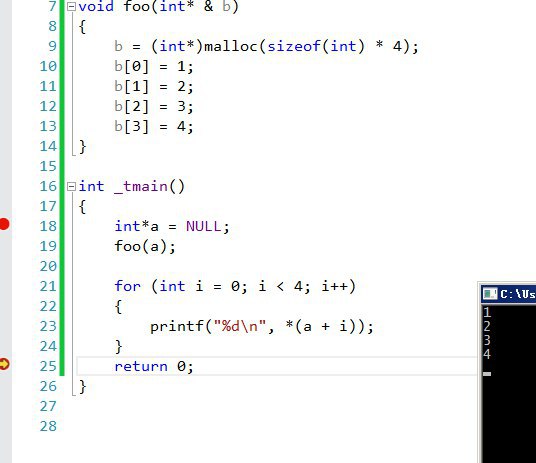
Then return int* or pass int**
Why? Without doing that why consecutive blocks of memory are not accessible outside of foo (via a)?
Artöm
Why? Without doing that why consecutive blocks of memory are not accessible outside of foo (via a)?
Cause b is a copy of a. When you change b, a holds old value
Mat
b doesn't exists anymore after foo is closed
Lao
the B pointer in foo , got NULL, not a 's address
Artöm
Why? Without doing that why consecutive blocks of memory are not accessible outside of foo (via a)?
Imagine a, b are int. b is copy of a. Here you have same situation
detergentTikiya
Cause b is a copy of a. When you change b, a holds old value
Doesn't a have the same address as b despite b doesn't exist anymore?
Artöm
Thing is, if oarameter is a pointer, it isn't always pass-by-reference
Artöm
Doesn't a have the same address as b despite b doesn't exist anymore?
Ofc not. They are different variables
detergentTikiya
Imagine a, b are int. b is copy of a. Here you have same situation
They are at two different memory addresses.
In my case, it's the same memory addres that a and b are pointing to
Artöm
They are at two different memory addresses.
In my case, it's the same memory addres that a and b are pointing to
Only before call. When b is changed, they point to different addresses
detergentTikiya
Only before call. When b is changed, they point to different addresses
How has b changed? It still points to the start of the memory block ..right?
Artöm
Artöm
a didn't
detergentTikiya
The malloc one
But I did a gdb..and just before foo exits, b holds the same address which it held at the beginning of foo
Artöm
Mat
Mat
And after?
detergentTikiya
So it has or points to are same