Really?
well why not
 Ariana

 Ariana
Ah you see
I use a fuzzy compiler which is my imagination
Ariana
XD
Ariana
true
Ariana
why haven’t someone created one yet
<looks at spaghetti code>
nevermind
 Anonymous
why haven’t someone created one yet
<looks at spaghetti code>
nevermind
Spaghetti code, it's been so long since I've seen one. Where did you see it?
Ariana
looks at hackathon codes 👀
Mat
Anonymous
why haven’t someone created one yet
<looks at spaghetti code>
nevermind
i see what were you talking here, the code looks delicious
Anonymous
I was given a question to find the sum of two numbers.the numbers can be int or float . But, I should print the exact answer.
Ex: 5 2
Ans: 7
5.2 3
Ans: 8.2 not 8.200000
5.5 6.5
Ans: 12 not 12.0
I took both the numbers as float summed them up.
K=(int)sum
If(sum==k)
printed("%d",k);
This will satisfy integer answers like 12 but how to print the float numbers like 8.2 when I don't know how many numbers are there after decimal.
 BinaryByter
cout will by default print the most resonable amount of precision
BinaryByter
use std::fixed for fine frained control
Anonymous
Idk c++
Anonymous
I was doing in c
Anonymous
use format specifier
Anonymous
Like?
Jussi
%f
Anonymous
printf("%3.3f\n", identifer);
Anonymous
%f would print 0s
Anonymous
We don't know whether it has 3 decimal portions or more or less
Anonymous
You wanted to print 4 digits so %.4f, but I don't know how many decimal places would be there in the sum
Anonymous
then leaving it to %f would be better
Anonymous
will print those extra 0s though
Anonymous
It would print extra 0s
Anonymous
Come on man it will not match the test cases
Anonymous
don't really know how to deal with it
Anonymous
/* gonna have a look at c programming language 2nd edition */
数学の恋人
A quick question, under what conditions might
a += b; and a = a + b; give different results?
Anonymous
your os?
Anonymous
😂
Anonymous
A quick question, under what conditions might
a += b; and a = a + b; give different results?
Never, but if you having product somewhere in between you may get different results
Anonymous
Ubuntu 19.04
Anonymous
Interesting
Anonymous
The c programming language book says %f won't print trailing zeros
Anonymous
 数学の恋人
数学の恋人
Never, but if you having product somewhere in between you may get different results
no it does give different result
数学の恋人
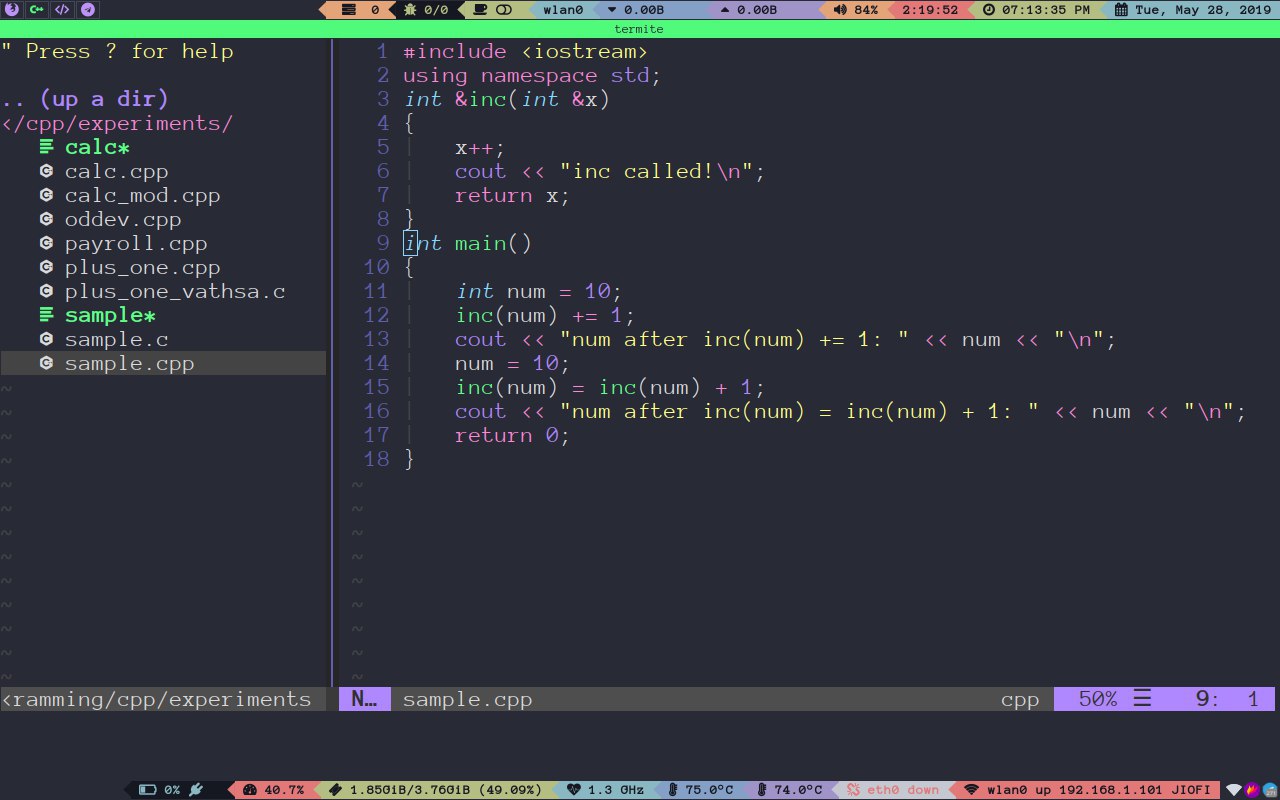
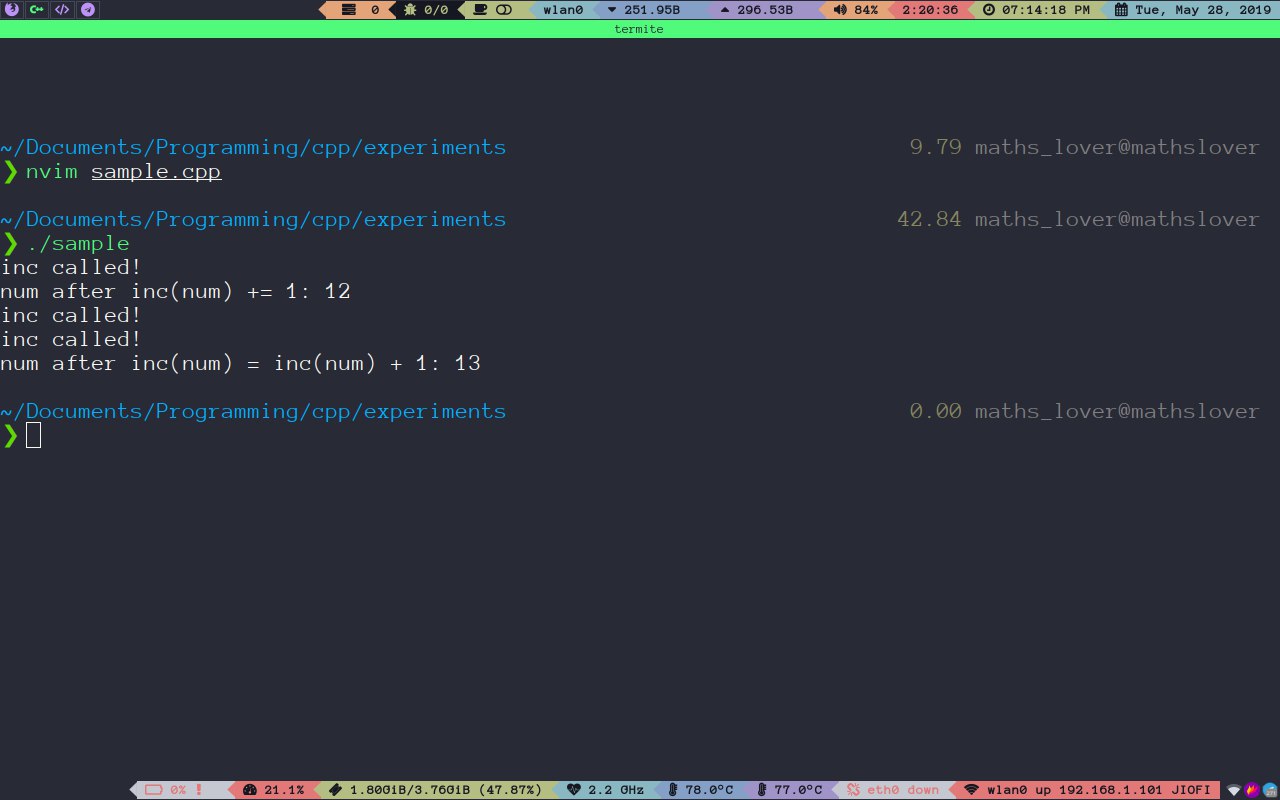 Anonymous
a compound assignment expression v1 op= v2 is equivalent to v1 = v1 op v2 but v1 is evaluated only once
edit: it's an equation but why do we call it an expression in programming?
Anonymous
but in v1 = v1 op v2; v1 is evaluated twice
数学の恋人
Anonymous
so another increment
Anonymous
so many memories with it
Anonymous
oh nice
 klimi
klimi
arent you red?
Anonymous
okie
 itsmanjeet
I don't know it possible or logical
But can we done something to use a file as storage heap in c programs
Like a file and all the variable and array etc stores in it
In other words
Using file as storage for variables and array for c program
Like initializing a variable normally
And it store automatically in file
BinaryByter
yes, its doable
BinaryByter
but its completely stupid, because file access is very slow and will damage the drive if you are using an SSD disk
BinaryByter
for how to do it look into mmap, std::allocator and fopen
BinaryByter
but its completely stupid, because file access is very slow and will damage the drive if you are using an SSD disk
also, string operations don't work on files
BinaryByter
also, in order to be used, the data will have to be loaded from the file
Mihail
but its completely stupid, because file access is very slow and will damage the drive if you are using an SSD disk
well umm "slowing down your program 101"
Mihail
I don't know it possible or logical
But can we done something to use a file as storage heap in c programs
Like a file and all the variable and array etc stores in it
In other words
Using file as storage for variables and array for c program
Like initializing a variable normally
And it store automatically in file
if you're just doing it for fun ok, but please never actaully do that in real code
BinaryByter
also, if you plan on storing your variables into a file from ram, i'm going to disillusion you: it will only work with a few variable types
BinaryByter
if you're just doing it for fun ok, but please never actaully do that in real code
unless you work at microsoft, then please do it