 BinaryByter


my favourite weird topic lol
 VJ
VJ
suggest me any link to learn pointers
BinaryByter
google, really
Mat
suggest me any link to learn pointers
I'd suggest videos. Probably you'll get faster the idea behind them if you visualize what's happening
BinaryByter
meh
BinaryByter
most videos are tedious
BinaryByter
unless you use newpipe which has up to 5x speedup
VJ
BinaryByter
this
BinaryByter
pointers are actually are pretty intuitive
BinaryByter
Let me give an analogy
BinaryByter
imagine you want to show people your house
BinaryByter
you could either show them pictures
BinaryByter
or you could give them your adress
BinaryByter
now what happens if you give them adress ++?
BinaryByter
they suddenly go to the next house
BinaryByter
by doing
*pointer, you make the people visit your house
BinaryByter
So you can either first increase the adress and then make them visit your hosue
VJ
nice explanation bro
BinaryByter
or you can first make them visit your house and once they are there you make them increase your house (whatever that means)
BinaryByter
Thanks :D
Anonymous
Hi please give me response
Anonymous
Give me basic ebook of c
Anonymous
Have you tried Amazon? They have plenty of them
Deniz
Hello everyone
Deniz
 Deniz
Deniz
 Deniz
Deniz
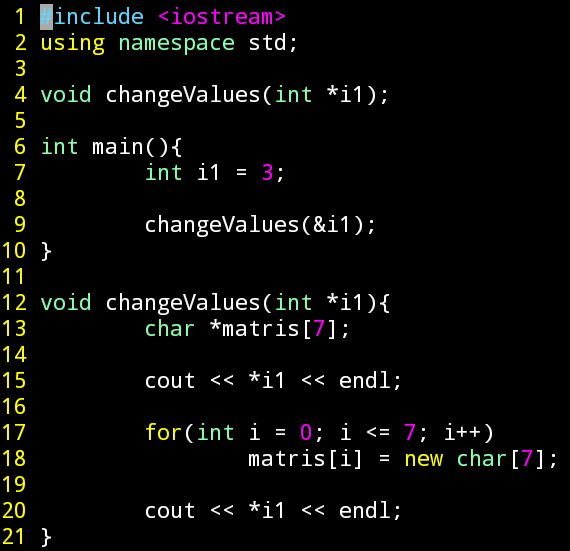
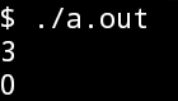
Why *i1 changes from 3 to 0? Helpp
 Pavel
Pavel
 klimi
VJ
klimi
VJ
#include<stdio.h>
int main()
{
int a[] = {1, 2, 3, 4, 5, 6};
int *ptr = (int*)(&a+1);
printf("%d ", *(ptr-1) );
// getchar();
return 0;
}
VJ
in this wat does *ptr stores??
Anonymous
#include <iostream>
using namespace std;
//Compiler version g++ 6.3.0
class base
{
void privatef()
{
cout<<"This is function from private scope\n";
}
public:
void publicf()
{
cout<<"This is function from public scope\n";
}
protected:
void protectedf()
{
cout<<"This is function from protected scope\n";
}
};
base()
{
publicf();
//privatef();
//protectedf();
}
base d;
class derived :public base
{
public:
derived()
{
//privatef();
publicf();
protectedf();
}
};
int main()
{
derived d1 ;
}
Anonymous
I want to access a public member function in the global scope by using an object. Here I used a constructor..
Anonymous
My objective is that I want to show that public member function can be accessed in the global scope and private and protected member functions cannot be accessible.How to prove this 
Anonymous
Anyone
Anonymous
help
BinaryByter
we are throwing stones at you because kings know how to build empires put of the stones thrown at them
Anonymous
Aakriti kaur
BinaryByter
look at his 3rd pfp
BinaryByter
your third pfp tells me that you shouldnt look for answers
klimi
maxi...
BinaryByter
kurimi?
 Ariana
reading unformatted code is a pain tbh
Ariana
My objective is that I want to show that public member function can be accessed in the global scope and private and protected member functions cannot be accessible.How to prove this 
how to prove it?
Try it and show that it fails by running it
Ariana
monospace
VJ
#include<stdio.h>
int main()
{
int a[] = {1, 2, 3, 4, 5, 6};
int *ptr = (int*)(&a+1);
printf("%d ", *(ptr-1) );
// getchar();
return 0;
}
VJ
in this wat does *ptr stores??
Ariana
formattt
Ariana
eyse huty
Ariana
try running it
Ariana
NO
Ariana
NO
Ariana
NO
Ariana
Like
Ariana
Do you know how to format on telegram
Ariana
How are you accessing tele rn(phone(apple/andriod/wtv), com, terminal, wtv)
BinaryByter
7)
Ariana
Which phone
Ariana
apple/andriod/idk
Mihail
Like this