 Alexander


Thank you for noticing this, I'll fix it
 Henri
Henri
Got a problem with datetimes and timedelta.
I want to compare the time when the cart was last updated to a the time in seconds in which the items in the cart are reserved for the customer. This are 2 of my tries:
valid_carts = Product[1].cart_items.filter(
lambda ci: (datetime.now() - ci.cart.last_updated)
<= timedelta(seconds=cart_reservation_time)
)
Henri
Or:
valid_carts = Product[1].cart_items.filter(
lambda ci: (datetime.now() - ci.cart.last_updated).total_seconds()
<= cart_reservation_time
)
Henri
Also tried to use timestamp() on both datetimes, but nothing worked.
With the first i get
NotImplementedError: timedelta(seconds=cart_reservation_time)
Henri
With the second:
AttributeError: 'timedelta' object has no attribute 'total_seconds': datetime.now() - ci.cart.last_updated.total_seconds
Henri
And with timestamp I get:
AttributeError: 'datetime' object has no attribute 'timestamp': ci.cart.last_updated.timestamp
Alexander
Try to use the first approach and define the timedelta value outside of the query:
td = timedelta(seconds=cart_reservation_time)
valid_carts = Product[1].cart_items.filter(
lambda ci: (datetime.now() - ci.cart.last_updated) <= td
)
Henri
Try to use the first approach and define the timedelta value outside of the query:
td = timedelta(seconds=cart_reservation_time)
valid_carts = Product[1].cart_items.filter(
lambda ci: (datetime.now() - ci.cart.last_updated) <= td
)
Cool! Seems to work!
You're great!
So you need to use this datetime stuff outside of Pony?
Alexander
It is supposed to work in queries as well, but as NotImplementedError shows, the constructor of timedelta with seconds keyword argument was not properly implemented yet
Alexander
I hope we can fix it in an upcoming release
Henri
Cool!
 aldo
aldo
good morning, trying to use sqlite extensions like fts5 and spatialite, but can't find documentation/examples
Alexander
Suppose you have an entity
class MyEntity(db.Entity):
id = PrimaryKey(int)
title = Required(str)
description = Required(str)
...
After you created the database and tables, you can execute an additional commands like the following:
sql_create_fts_table = """
CREATE VIRTUAL TABLE IF NOT EXISTS FtsIndex USING FTS5
(title, description, content='MyEntity', tokenize='porter unicode61 remove_diacritics 1');"""
sql_add_fts_trigger_insert = """
CREATE TRIGGER IF NOT EXISTS fts_ai AFTER INSERT ON MyEntity
BEGIN
INSERT INTO FtsIndex(rowid, title, description) VALUES (new.rowid, new.title, new.description);
END;"""
sql_add_fts_trigger_delete = """
CREATE TRIGGER IF NOT EXISTS fts_ad AFTER DELETE ON MyEntity
BEGIN
DELETE FROM FtsIndex WHERE rowid = old.rowid;
END;"""
sql_add_fts_trigger_update = """
CREATE TRIGGER IF NOT EXISTS fts_au AFTER UPDATE ON MyEntity BEGIN
DELETE FROM FtsIndex WHERE rowid = old.rowid;
INSERT INTO FtsIndex(rowid, title) VALUES (new.rowid, new.title, new.description);
END;"""
with db_session(ddl=True):
cursor = self.db.get_connection().cursor()
cursor.execute(sql_create_fts_table)
cursor.execute(sql_add_fts_trigger_insert)
cursor.execute(sql_add_fts_trigger_delete)
cursor.execute(sql_add_fts_trigger_update)
and then in your query you can do something like
fts_query = "foo bar*"
select(
obj for obj in MyEntity
if raw_sql("""
id in SELECT(rowid from FtsIndex WHERE FtsIndex MATCH $fts_query)
""")
)
Can't say about spatialite, I haven't had experience with it
aldo
thank you, would see if can create some functions to simplify the use. by the way, there is a typo in the query, it should be id in (SELECT rowid from FtsIndex WHERE FtsIndex MATCH $fts_query) (note the parenthesis)
Alexander
you are right :)
aldo
https://gist.github.com/ne555/2a14c257ee82f33b110daf16b28c3ae2
aldo
the class would need to fill the parameters of generate_fts() and forward the search_fts() call. (just one fts index per class)
Alexander
Looks viable. The _search_fts query misses the WHERE condition (or maybe you plan to pass it as a part of the argument)
aldo
FROM {table}_fts($value) that's equivalent to FROM {table}_fts WHERE {table}_fts MATCH $value
aldo
perhaps change it to the second form
 Amo
Amo
How long for python 3.12 support? 🤭
Alexander
I hope not as long as for 3.11 :)
 Vitaliy
At the first glance 3.12 is supported as well.
Alexander
We need to handle the JUMP_BACKWARD opcode; without it, the support of Python 3.11 is incomplete. I plan to make a new release soon for that reason.
For 3.12, there are a bunch of new opcodes, but I hope it should not be too hard to add support for them.
aldo
good morning, how to rebind the db? tried to do db.disconnect() but when binding again it raise the error <class 'pony.orm.core.BindingError'> Database object was already bound to SQLite provider
 Alexander
binding is not connecting
Alexander
binding means "create tables for me for this specific database"
aldo
ok, so how to connect?
Alexander
If your method or function is decorated with @db_session - pony will connect by itself
aldo
I have several .db files (all have the same tables), have to change to which .db file want to connect
Alexander
you can import db object from file
aldo
from pony import orm
db = orm.Database()
class TestEntity(db.Entity):
name = orm.Required(str)
db.bind(
'sqlite',
filename='¿?' # not defined yet
)
# all the db have the same tables and are already populated
db.generate_mapping(create_tables=False)
def foo(file):
db.connect(file)
with orm.db_session:
return TestEntity.get(name='asdf')
# want to connect to different databases
foo('a.db')
foo('b.db')
foo('c.db')
aldo
how to implement foo() so can change the .db file to load
Alexander
remove db.connect from function
Amo
Or pass db as parameter to foo
aldo
I only have one db object that want to change the file that it refers to
aldo
or should have db_a, db_b, db_c and generate the mapping for each one?
Alexander
db1 = orm.Database("sqlite", ...)
db2 = orm.Database("postgres", ...)
db3 = orm.Database("mysql", ...)
def define_entities(db):
class TestEntity(db.Entity):
name = orm.Required(str)
db.generate_mapping(...)
define_entities(db1)
define_entities(db2)
define_entities(db3)
def get_by_name(db, name):
with orm.db_session:
return db.TestEntity.get(name=name)
Jeff
anyone have any luck integrating pony orm with strawberry to make graphql apis?
Santosh
I have any issue in Querying the for JSON filed.
Here is my entity defined.
class Contract(database.Entity):
_table_ = 'odm_contract'
contract_id = orm.PrimaryKey(str)
contract_name = orm.Required(str)
application_id = orm.Required(str)
contract_details = orm.Optional(orm.Json)
Query is as below.
sql = """
SELECT * FROM odm_contract WHERE application_id = "0oa9ldovf85vOE11L0h7" and JSON_CONTAINS(contract_details, '{"name": "0"}', '$')
"""
contracts = database.execute(sql)
And I get error as below.
contracts = database.execute(sql)
File "/opt/python/pony/orm/core.py", line 870, in execute
return database._exec_raw_sql(sql, globals, locals, frame_depth=cut_traceback_depth+1, start_transaction=True)
File "/opt/python/pony/orm/core.py", line 880, in _exec_raw_sql
adapted_sql, code = adapt_sql(sql, provider.paramstyle)
File "/opt/python/pony/orm/core.py", line 238, in adapt_sql
try: expr, _ = parse_expr(sql, i+1)
File "/opt/python/pony/utils/utils.py", line 270, in parse_expr
if match is None: raise ValueError()
ValueError
Santosh
Can someone help me please, the same query works with MySQL.
@akozlovsky and Others please need to quick solution for this
Santosh
@all I would be interested to know what's worng here.
And contract details here will have an array of Json object and name is one of key.
I had implemented as below.
contracts = orm.select(cd for cd in Contract if cd.application_id == application_id)
menu_map = {constants.NAME: menu_name}
sql = "JSON_CONTAINS(contract_details, '{0}')".format(json.dumps(menu_map))
contracts = contracts.where(lambda: orm.raw_sql(sql))
It would work, except for special chars $ and % in name value
Alexander
Hi Santosh, what database do you use?
Santosh
I use MySQL
Alexander
You need to use $$ instead of $, as $ has a special meaning in PonyORM raw queries. In the resulted SQL query, $$ will be replaced with a single $
Santosh
How about %
Santosh
Input can be any string so do you recommend to replace $ with $$ and % with $% if come across these chars anywhere in the string
Alexander
In PonyORM raw SQL queries, single $ is used for parameters, like $x or $(a + b)
Regarding %, I do not remember, it depends on a lower level mySQL driver and the way it handles params. If % is used inside a string literal (similar to '$' in string literal in your query), then probably it also should be replaced with %%.
Alexander
Input can be any string so do you recommend to replace $ with $$ and % with $% if come across these chars anywhere in the string
That means that you basically receives the text of the SQL query from the outside. It is dangerous and can lead to an SQL injection
Usually the text of SQL query should be defined in the application, and only param values should be received from the outside
Alexander
If what you get from the outside is not an arbitrary SQL query fragment, but just a name, then you can check with a regex that it is indeed a name and nothing else, and replace % and $ with %% and $$
Santosh
Santosh
That means that you basically receives the text of the SQL query from the outside. It is dangerous and can lead to an SQL injection
Usually the text of SQL query should be defined in the application, and only param values should be received from the outside
No there is validation check, but I cant have any character restrictions, also it won’t be unknown data
 PSoftware 👨🏻💻
hi, good morning
PSoftware 👨🏻💻
need help, please!
PSoftware 👨🏻💻
 PSoftware 👨🏻💻
 Alexander
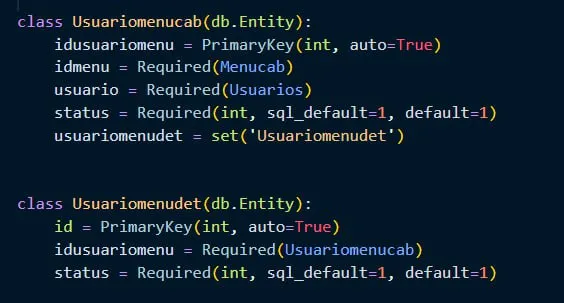
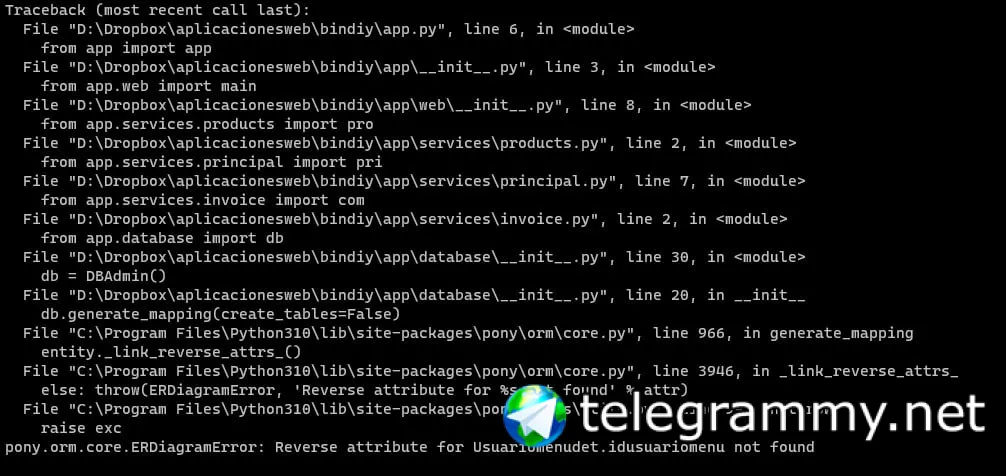
Use Set, not set when defining usuariomenudet
PSoftware 👨🏻💻
thanks!
aldo
db1 = orm.Database("sqlite", ...)
db2 = orm.Database("postgres", ...)
db3 = orm.Database("mysql", ...)
def define_entities(db):
class TestEntity(db.Entity):
name = orm.Required(str)
db.generate_mapping(...)
define_entities(db1)
define_entities(db2)
define_entities(db3)
def get_by_name(db, name):
with orm.db_session:
return db.TestEntity.get(name=name)
good morning, sorry for the late reply (don't work outside work hours). although that would work, it generates the mapping over and over again, don't see the need for that as I don't change the provider (dunno if it is expensive).
Alexander
db.generate_mapping should be called once
aldo
about define_entities(db), have all my models in separate files. cannot do def define_entities(db):
from . import models
Alexander
db object has models references inside it
aldo
db.generate_mapping should be called once
each time you call define_entities() there would be a call to generate_mapping(). I know that they are different objects, my point is that the mapping is the same.
Alexander
you call define_entities once
Alexander
If you run generate_mapping without create_tables=True it should be pretty fast, it just creates table definitions in memory and checks that tables with the specified names are indeed present in the database
aldo
ok, would create some factories... as an alternative, what's the worst that would happen if simply do db.provider = None and then bind to the other file
Alexander
Are all of your databases the SQLite databases with exactly the same structure?
Alexander
Is your code single-threaded or multi-threaded?
aldo
yes, sqlite, same structure. multi-threaded
Alexander
Switching the db file isn't the supported behavior, but you can try:
1. After you send queries to the database, it keeps open connections in the connection pool, one connection for each thread from where the database was used. Before switching to a different database file, you should do db.disconnect() from each thread that worked with the database before. Otherwise, you'll reuse the connection to a previous database file when working with a new database file.
2. If you performed db.disconnect() from all threads, you can do db.provider.pool.filename = new_filename to switch to a different database file, and after that, Pony should work with a new database. Pony will expect the new database contains proper tables
aldo
great, thank you. will test it later
 Oualid
any solution for migration.?
 Ben
Ben
Is it possible to do a "in" search in the integrity of a JSON column? Or a way to cast the JSON column to string and then do that "in" query?
Alexander
Is it possible to do a "in" search in the integrity of a JSON column? Or a way to cast the JSON column to string and then do that "in" query?
What do you mean? Like, obj for obj in MuEntity if item in obj.json_array_column and obj for obj in MyEntity if key in obj.json_dict?
Ben
Yes exactly, it seems that in only works if I specify a key to match in, and even then it only works with exact match. Like obj for obj in MyEntity if search_string in obj.json_column['name']
Ben
I have columns with {"name": "John"} but if I have the search string being Jo it does not find them, it only works if it is John
Alexander
What database do you use?
Ben
And obj for obj in MyEntity if search_string in obj.json_column does not return anything no matter if it's exact match or not
Ben
I use Postgres 14
Ben
Ok actually if I cast with str() it seems to work. Like obj for obj in MyEntity if search_string in str(obj.json_column)